APU Software

Loudness Limiter

Set limits for loudness and peaks

Sale price $30.00 one-time · Regular price $40.00

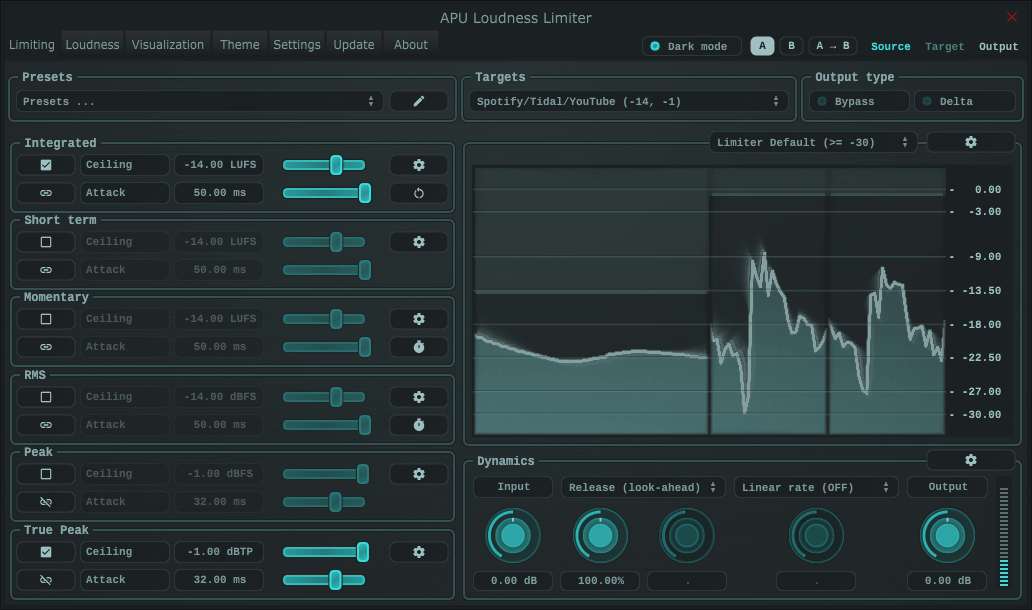
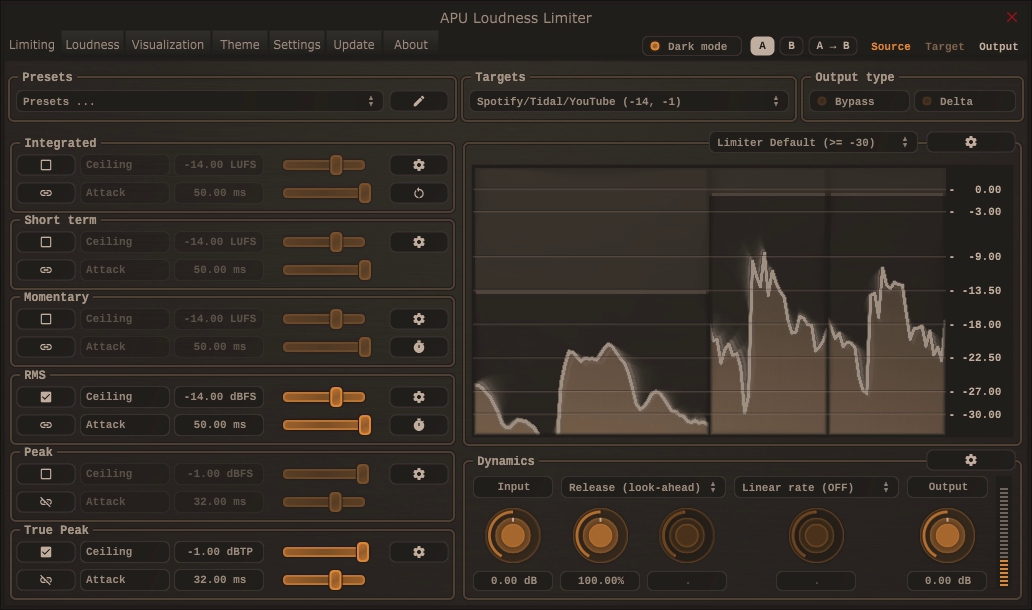
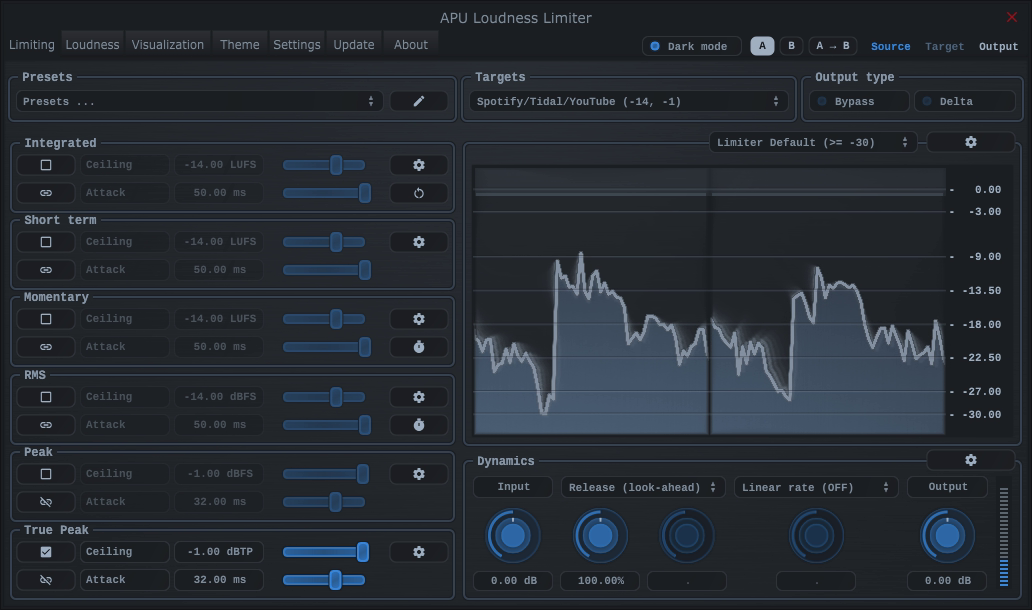
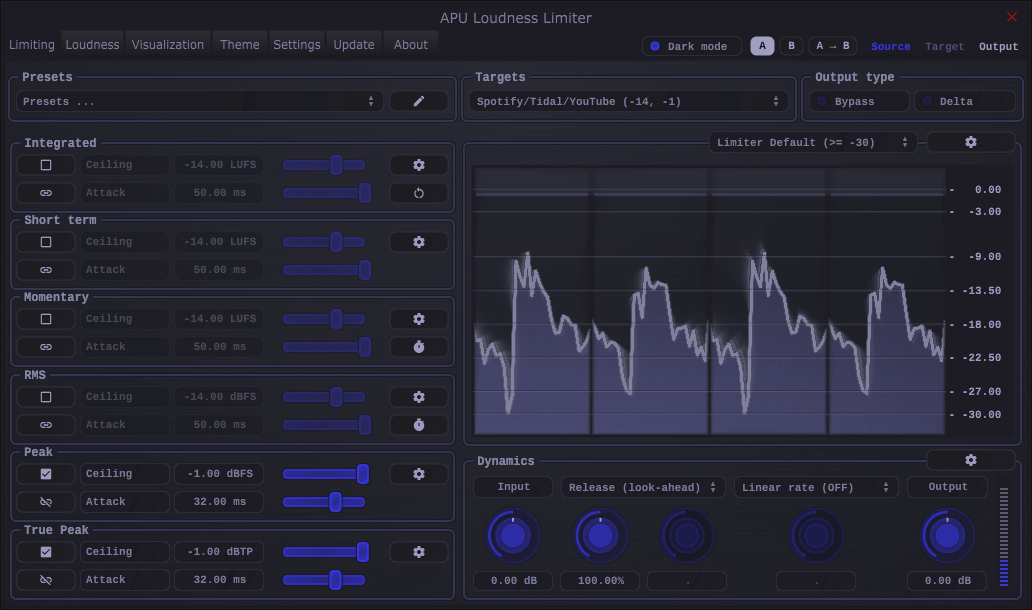
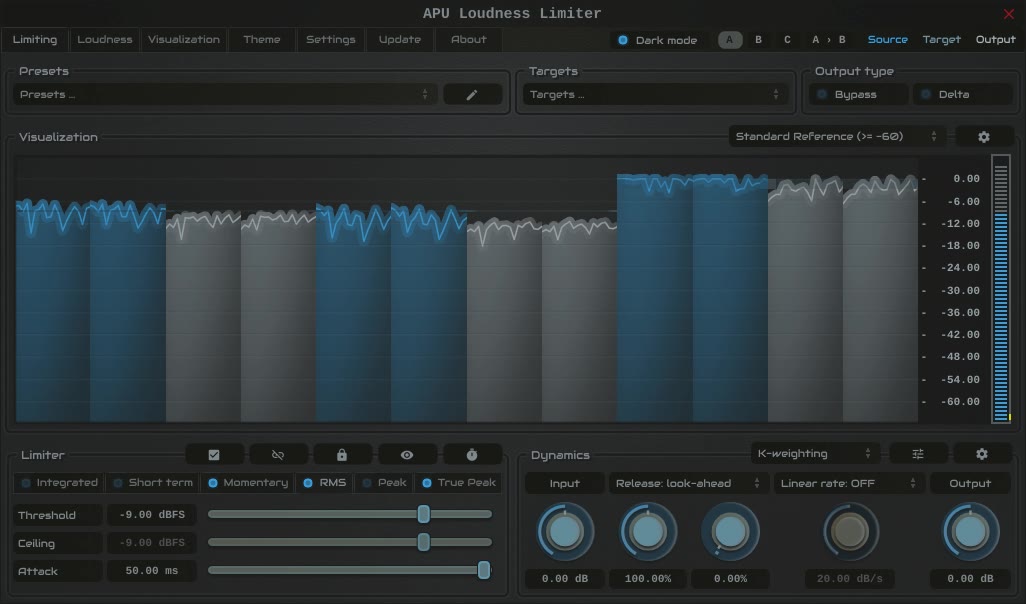
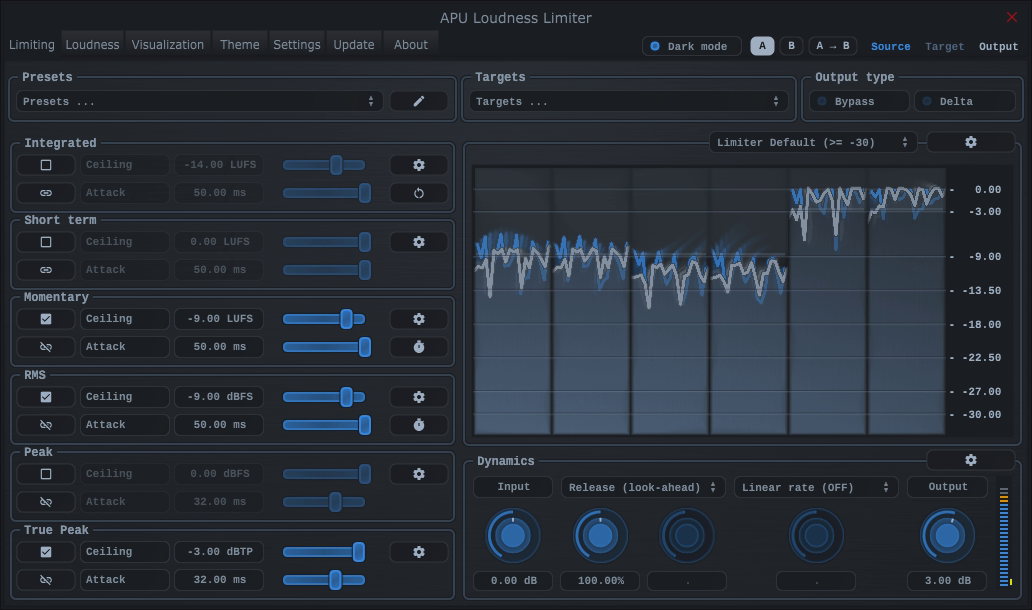
APU Loudness Limiter interface
APU Loudness Limiter demonstration
Fall Sale: 25% Off automatically applied at checkout.

APU Loudness Limiter controls output loudness and catches peaks on tracks, mixes, or streams. Use it when you want to limit how loud a passage gets as well as its highest peaks.

Set limits for Momentary, Short-Term, or Integrated LUFS alongside RMS, Peak, and True Peak. Channels can share gain reduction or be processed independently, including in surround and Dolby Atmos® formats.

Adjust Threshold, Ceiling, Attack, Release, and Look-ahead to control the response. Natural and Inertial ballistics offer different gain envelopes; Linear Release changes gain at a constant rate. Timing budgets let you adjust attack and look-ahead within an allocated delay without changing the plug-in’s reported latency. Optional dithering is also available.

To bring overall loudness closer to a target, learn a gain correction from Average or Integrated output loudness during a representative pass, then lock it for playback or export. This correction is applied before Peak and True Peak limiting.

Compare source, target, and output loudness in a rolling history or histogram. Save histogram snapshots for comparison, or use the breath residual view to see where output loudness differs from the target.

Presets provide starting points for streaming and broadcast loudness targets, including Spotify, Apple, and EBU R128. External sidechain input is also supported.

Fall Sale
Download (30-day Trial)

Note: Existing customers can apply their loyalty discount on the cart page.
System requirements: macOS 10.14 (x64, ARM), Windows 10 (x86, x64), OpenGL 3.2.
Supported software formats: Standalone application, VST, AU, AAX (Pro Tools 11+).
Measurement Modes

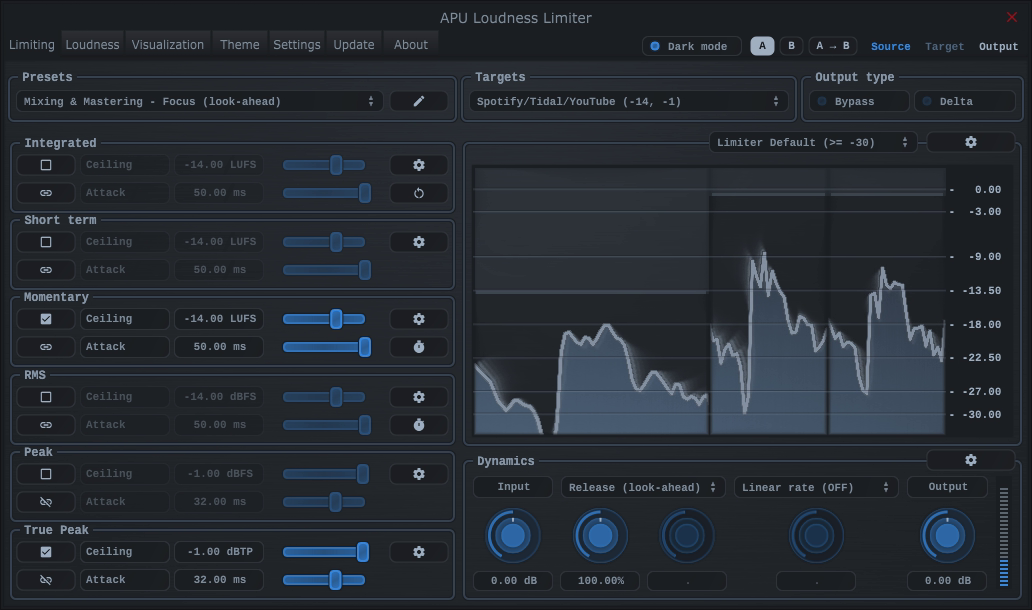
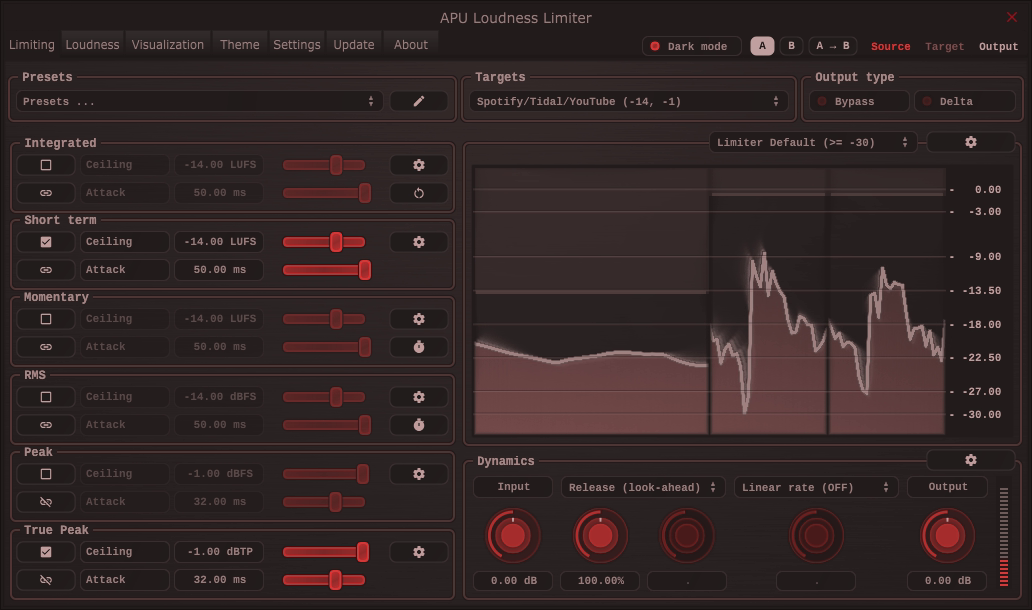
Enable one or more measurement types to limit loudness and peaks together. Link channels to apply the same gain reduction across them, or split them for independent processing.

Momentary

Momentary measures loudness over a 400 ms window with K-weighting and channel weighting. It follows shorter changes in loudness.

Momentary LUFSView full size

Short-Term

Short-Term measures loudness over a 3-second window, following longer changes in level. It uses the same K-weighting and channel weighting as Momentary.

Short-Term LUFSView full size

Integrated

Integrated measures loudness over the measurement run, using K-weighting, channel weighting, and relative and absolute gating. It lets limiting respond to the accumulated loudness measurement.

Integrated LUFSView full size

RMS

RMS measures signal level over an adjustable window, set to 150 ms by default. It does not apply K-weighting or channel weighting.

RMSView full size

True Peak

True Peak estimates peaks between samples as well as sample peaks, so those estimates can drive limiting. It uses the configured block interval, which is 1 ms by default.

True PeakView full size

Peak

Peak measures sample peaks over the configured block interval, which is 1 ms by default. It does not estimate peaks between samples.

PeakView full size

Back to top

Alternate Weighting

Alternate weighting curves change how much each frequency contributes to the detector. Use them to adjust how strongly bass, midrange, or high-frequency content drives the limiter. Measurements with alternate weighting are no longer standard LUFS measurements.

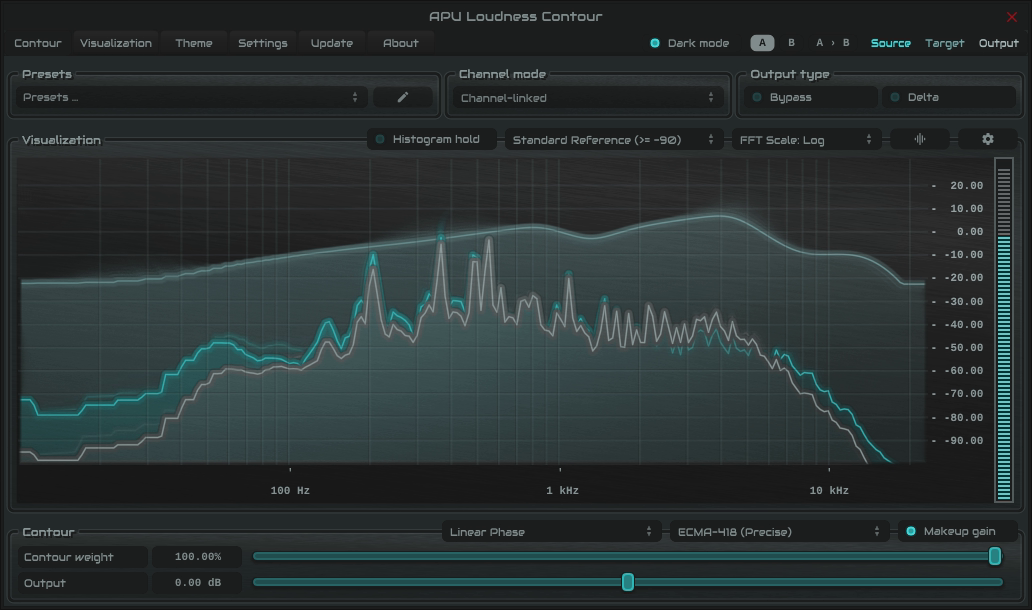
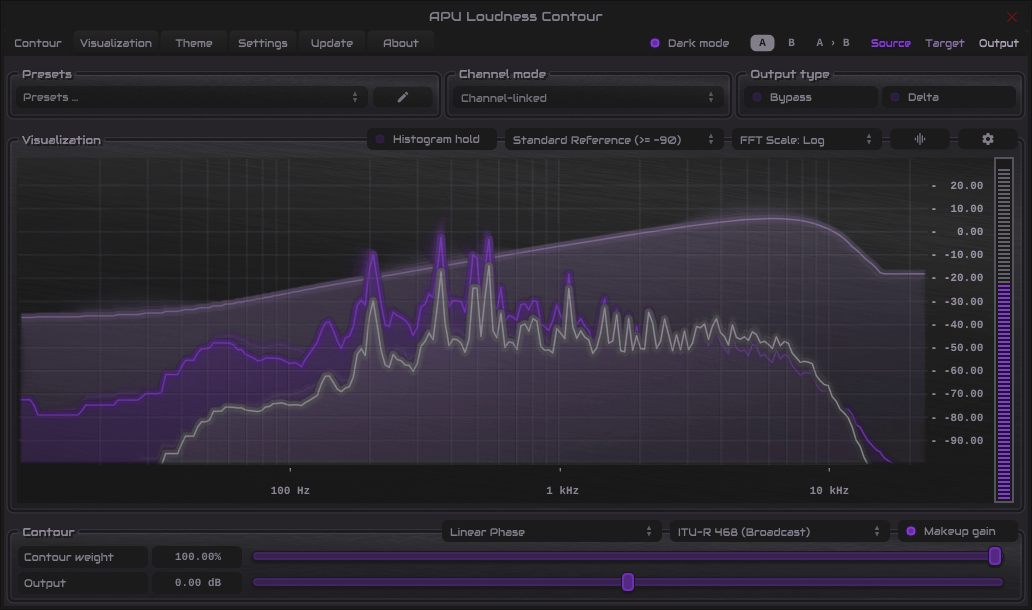
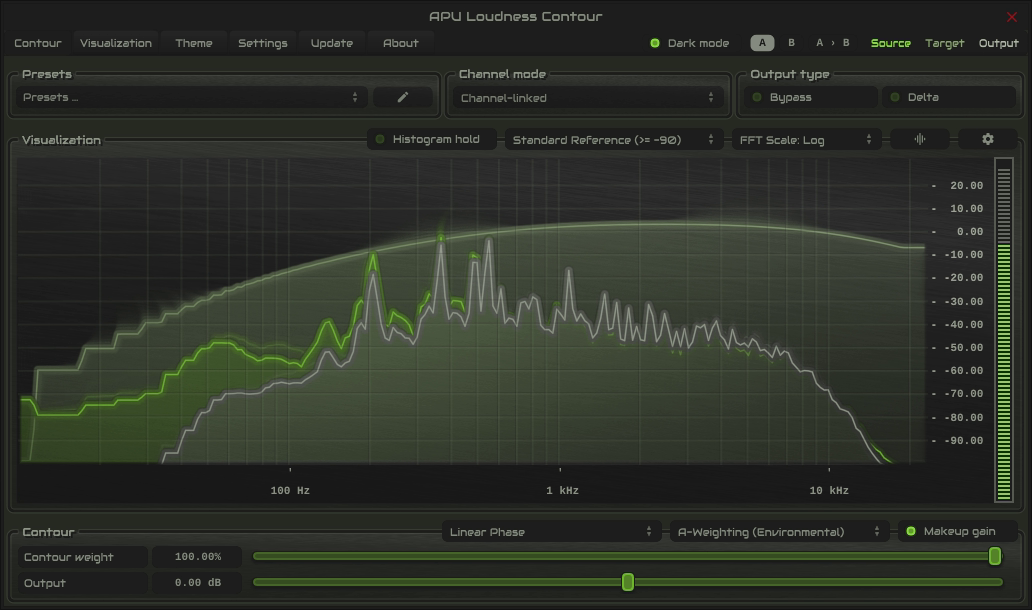
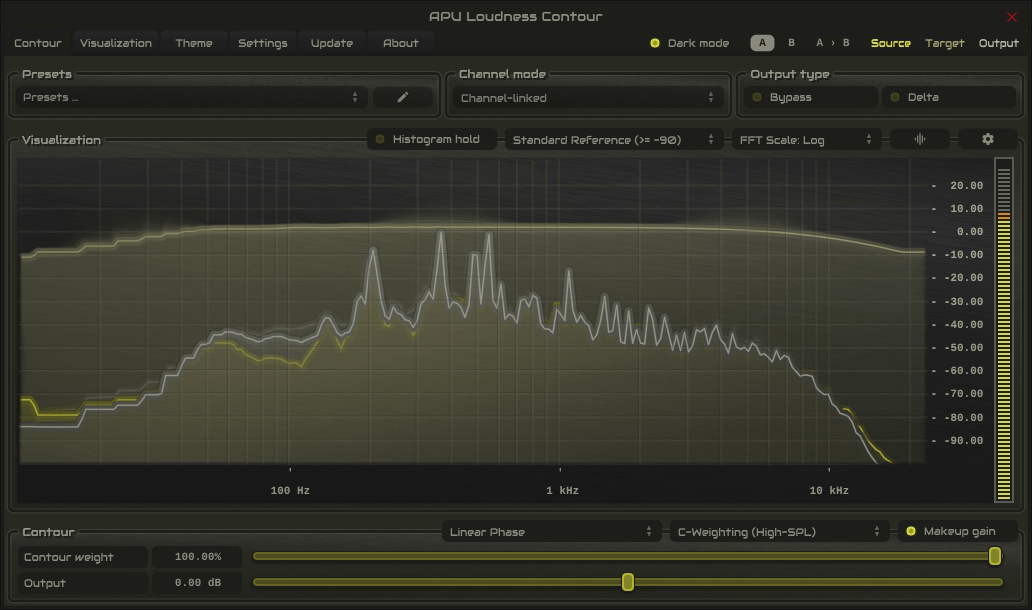
The screenshots below show the curves in Loudness Contour. The limiter applies them as zero-latency IIR filters in the detector path.

ECMA-418

ECMA-418 uses the outer- and middle-ear weighting curve from the ECMA-418-2 hearing model. It provides an alternative to K-weighting; it does not apply the standard’s full loudness model.

ECMA-418View full size

ITU-R 468

ITU-R 468 emphasizes the upper midrange, making the detector more sensitive to sibilance and other high-frequency content. Gain changes still affect the whole signal.

ITU-R 468View full size

A-weighting

A-weighting reduces the influence of low frequencies. Use it when you want bass to contribute less to limiting.

A-weightingView full size

C-weighting

C-weighting is flatter than A-weighting and retains more low-frequency energy in the detector.

C-weightingView full size

Back to top

Actual size

Shown at its native size. Swipe or scroll to explore the full interface.